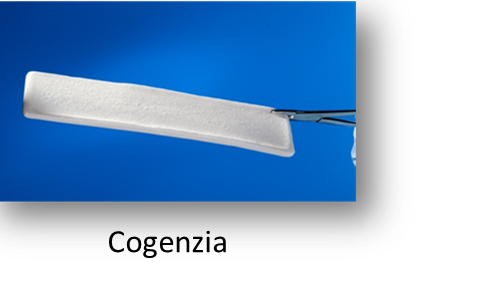
Cogenzia gentamicin collagen sponge
Cogenzia is a biodegradable and fully resorbable gentamicin-collagen sponge formulated and manufactured using Innocoll's proprietary collagen-based drug delivery technology, CollaRx®.
Upon topical application to an open wound the product releases gentamicin, a broad-spectrum, aminoglycoside antibiotic with a concentration-dependent mechanism of action, for local action at the wound site. This ensures a high concentration of drug at the target tissue, while maintaining low systemic levels well below the toxicity threshold. Two product sizes are being developed (5x5 cm & 2.5x2.5 cm), which both deliver 50 mg of gentamicin sulfate (equivalent to 32.5 mg of gentamicin).
With strong support from Key Opinion Leaders in the field, Innocoll is developing Cogenzia as adjuvant therapy for the treatment of infected diabetic foot ulcers (DFIs).
"Topical therapy has many potential advantages, including high local antibiotic levels without systemic levels, limited total antibiotic usage and avoidance of systemic toxic effects. Preliminary data on collagen sponges and existing data on locally applied gentamicin suggest that this is a potentially beneficial method of treating diabetic foot infections."
Ben Lipsky MD - Professor of Medicine University of Washington
Clinical Development
Cogenzia is currently in phase 3 development for the adjuvant treatment of diabetic foot infections (DFIs). The phase 3 clinical protocol has been agreed by the FDA under a Special Protocol Assessment (SPA) and deemed appropriate by the EMA in response to a request for scientific advice. Top-line efficacy data from the phase 2 trials completed to date are summarized below:
|
In one randomized, controlled trial, Cogenzia was applied daily for up to 4 weeks in combination with systemic antibiotic therapy for the treatment of moderately-infected diabetic foot ulcers. Of the patients randomized to receive Cogenzia who completed the study, 100% achieved clinical cure compared to just 70% of patients who received systemic antibiotic therapy alone (P = 0.024). Patients in the Cogenzia group also had a higher rate of baseline pathogen eradication at all study visits (P ≤ 0.038) and a significantly reduced time to pathogen eradication (P < 0.001). View this published study.
In addition to its development as an adjunct to systemic antibiotic therapy for the treatment of DFIs, Cogenzia is also in phase 2 for the prevention of DFIs. Future clinical development opportunities include the treatment and prevention of chronic wound infections in other wound etiologies such as venous, arterial, and decubitus ulcers and potentially malignant wounds, which are particularly prone to infection. |
Market Opportunity
There were 26.8 million diabetic patients in the US in 2010 and 284 million patients globally. Of these patients, approximately 15% will develop a foot ulcer and 50% of those ulcers will become infected, representing an estimated 2 million patients. DFIs are currently treated with systemic antibiotics. However, diabetic ulcers are often associated with limited perfusion due to vascular disease and ischemia thereby rendering systemically acting antibiotics ineffective. According to meta-analysis of 18 randomized controlled trials evaluating different antibiotics in treatment of diabetic foot infections, the combined observed treatment failure rate of antibiotic treatments of DFI infections is 22.7%.
Diabetic foot is the most common cause of nontraumatic lower extremity amputations in the US and Europe, with an average of 82,000 amputations per year in the US costing an estimated $1.6 billion annually. In fact, every 20 seconds a diabetic foot is amputated. The estimated cost of foot ulcer care in the US ranges from $4,595 per ulcer episode to more than $28,000 and the total annual cost of foot ulcer care in the US has been estimated to be as high as $5 billion.
Local antibiotic treatment adjunct to a systemic agent can potentially address the unmet need in DFIs by improving antibacterial efficacy at the wound site. There are currently no approved, topically-applied antibiotics indicated for the treatment of DFIs.
For more information on this product, or to discuss partnership opportunities, please contact our business development team.